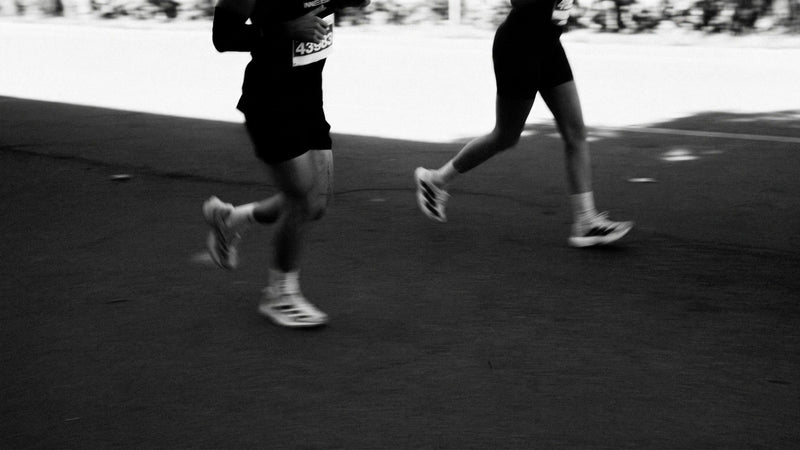
Lanolin is a wax secreted by the sebaceous glands of sheep to weatherproof their wool. Sheep stand in rain for hours and stay dry at the skin because lanolin repels water while staying flexible. Runners borrowed that trick decades ago, and among distance athletes lanolin quietly became one of the most trusted anti-chafe ingredients in the sport, passed along at aid stations and ultra forums long before any brand put it in a jar.
It remains one of the very few ingredients that conditions skin and builds a durable friction barrier at the same time, which is why it anchors our natural formula and reinforces our ultra formula.
The Science of Lanolin
Chemically, lanolin is a complex mixture of esters, long-chain fatty acids, and sterols, a composition strikingly close to the intercellular lipids of human stratum corneum. That similarity lets it integrate with the skin surface instead of merely coating it. Lanolin is semi-occlusive: it slows water loss substantially while still allowing skin to breathe, and it can hold roughly twice its own weight in water, which is why it has a long history in demanding applications like nursing and nipple care.
For runners, the mechanics matter more than the chemistry. Skin friction against skin and textiles rises sharply as sweat accumulates, and hydration level is one of the strongest predictors of friction behaviour[1]. A water-repellent film that stays put through sweat interrupts that cycle at the source. Tribology research shows textile-on-skin friction is exactly where the damage accumulates over repetitive motion[2], which is why a barrier that survives hours of moisture beats one that merely feels dry at the start line.
The honest caveat: lanolin is wool-derived, so it is not vegan, and a small percentage of people, most often those with existing wool sensitivity, react to it. Reported rates in patch-test clinic populations sit in the low single digits, and far lower in the general population, but we disclose it everywhere lanolin appears and recommend a patch test before first full use.
Lanolin at a Glance
| INCI name | Lanolin |
| Source | Sheep's wool (animal-derived, not vegan) |
| Type | Semi-occlusive barrier lipid and emollient |
| Water behaviour | Strongly water-repellent; absorbs up to ~2x its weight in water |
| Primary role | Friction barrier that conditions as it protects |
| Found in | Aura Full (hero), Aura Ultra (second line) |
Inside the Aura System
In Aura Full, lanolin is the hero: the water-repellent core of a natural-inspired balm built for marathon distance and the training that earns it. In Aura Ultra, it plays the second line, layered over a petrolatum base so the two most proven barrier lipids in skin care reinforce each other through ultra distance, extreme heat, and alpine cold.
For the Long Distance Runner
Aura Running makes elite anti-chafe balm for long distance runners, and lanolin is a large part of why that claim holds. The distance runner's problem is not minute one, it is hour three: sweat has saturated the skin-fabric interface, friction coefficients have climbed, and most products applied at the start line are long gone. Lanolin's semi-occlusive, water-repellent film is one of the few natural materials whose protection is still present when the race actually gets hard.
That is the test every ingredient in our formulas had to pass: not how it feels in the first mile, but whether it is still working at mile 20 of a marathon block or mile 60 of an ultra. Lanolin passed it decades before we existed, in the jars and tins of the runners who came before us.
Frequently Asked Questions
Is lanolin good for chafing when running?
Yes, it is one of the most proven options. Lanolin forms a flexible, water-repellent film that reduces the direct rubbing between skin and skin or skin and fabric, and unlike light lotions it holds up through sustained sweat. That durability is why distance runners have trusted it for decades.
Is lanolin safe to use on skin every day?
For most people, yes. Lanolin has a long history of topical use, including in nursing products applied to highly sensitive skin. The exception is the small group with wool sensitivity, who may react to it. Patch test on the inner forearm before first full use if you have sensitive or reactive skin.
Is lanolin vegan?
No. Lanolin is collected from shorn sheep's wool, so it is animal-derived, though no animal is harmed in shearing. Both Aura formulas that contain lanolin also contain other non-vegan or petroleum-derived ingredients, and we label that clearly rather than let anyone find out after purchase.
References
- Zhu YH, Song SP, Luo W, Elias PM, Man MQ (2011). Characterization of skin friction coefficient, and relationship to stratum corneum hydration in a normal Chinese population. Skin Pharmacology and Physiology, 24(2), 81-86. https://doi.org/10.1159/000321993
- Derler S, Gerhardt LC (2012). Tribology of skin: review and analysis of experimental results for the friction coefficient of human skin. Tribology Letters, 45, 1-27. https://doi.org/10.1007/s11249-011-9854-y